









Strengthening Sentinel-1 Processing Through Automated RFI Detection
Synthetic Aperture Radar (SAR) data play an important role in Earth observation by enabling consistent monitoring independent of weather conditions or daylight. With its powerful SAR instrument, the Copernicus Sentinel-1 satellite enables science, innovation, and commercial applications: from environmental monitoring to precision agriculture, to urban planning, or emergency response.
However, SAR systems operate in shared frequency bands and can therefore be affected by radio-frequency interference (RFI), which can lead to image artifacts, undetected biases or even complete data loss. Comprehensive filtering techniques are required to avoid image degradation and enable strong downstream analytics.
Most existing approaches to RFI detection rely on large raw SAR products, which are not always suitable for operational processing. In practice, Sentinel-1 workflows predominantly use compact products such as quicklooks and Level-2 ground range detected (GRD) imagery. The lack of robust RFI mitigation at these processing levels represents a limitation for large-scale and automated use of Sentinel-1 data.
The ClearSAR Challenge aims to address this gap by encouraging the development and benchmarking of automated RFI detection methods that are scalable and compatible with the Sentinel-1 processing chain.
The mission
This is where you come in:
Your mission is to develop and benchmark automated methods for detecting radio-frequency interference in Sentinel-1 SAR quicklook (RGB) imagery. Using a curated dataset of Sentinel-1 quicklooks with annotated RFI events, you will design solutions that are robust and scalable, proving them to be usable for large-scale and rapid monitoring scenarios.
Track 1 reflects the most widely available Sentinel-1 product level and targets operationally relevant RFI detection approaches that can support data-quality monitoring across the mission.
🙋 Wait, why Track 1? Is there a… Could there be a…?
We can’t tell you too much for now, other than: stay tuned!
The data
Participants are provided with an AI-ready dataset of Sentinel-1 quicklook (RGB) images designed for operational RFI detection. The dataset comprises 3,940 images, curated to reflect realistic mission conditions and a broad diversity of RFI characteristics.
The data are split into training and test sets using multiple criteria to ensure balanced representation across geographic regions, RFI sizes, and types of interference. The training set includes 3,154 images with ground-truth annotations in the form of bounding boxes indicating RFI artifacts. The test set consists of 786 images, with a subset used for validation during the challenge.
To support fair and reproducible evaluation, performance is assessed using mean Average Precision (mAP) computed across multiple Intersection-over-Union (IoU) thresholds. A reference implementation of the evaluation metric is provided as part of the starter pack, and challenge rankings are based on mAP scores.
The prizes
Your work will be rewarded. The top three teams will be eligible for a cumulative 5000 EUR cash prize:
🥇 1st place: 2,500 EUR + invitation to visit the ESA Centre for Earth Observation (Frascati, Italy) + diploma
🥈 2nd place: 1,500 EUR + diploma
🥉 3rd Place: 1000 EUR + diploma
But there’s more than just some cash:
📃 Joint journal paper: The best-performing teams will be invited to contribute to a high-impact journal paper summarizing the ClearSAR Challenge.
👀 Public visibility: The winners of the ClearSAR Challenge will be publicly awarded during IEEE ICIP 2026 held in Tampere, Finland from 13-17 September 2026. To help you with your travels, we will reimburse up to 500 EUR per team to attend the ICIP. Oh, and don’t worry, we’ll cover your registration fee.
The timeline
Please note that, due to the nature of this Challenge, there are two types of deadlines:
Deadlines related to the Challenge itself (D-C)
Deadlines related to the paper that should be submitted to ICIP 2026 (D-P)
- (D-C) Announcement of the ClearSAR-Track 1 Challenge: February 11, 2026
- (D-C) Launch of the ClearSAR-Track 1 Challenge and dataset access: February 27, 2026
- (D-C) On-line workshop for the ClearSAR-Track 1 Challenge: Ca. first week of April 2026 (exact date to be announced)
- (D-C) Closing the ClearSAR-Track 1 Challenge (frozen leaderboard): May 13, 2026
- (D-P) Two-page extended abstract submission to IEEE ICIP 2026: May 13, 2026
- (D-C) Reproducibility check by organizers (Top 10 teams): May 20 – June 30, 2026
- (D-P) Two-page abstract acceptance notification: June 10, 2026
- (D-P) Camera-ready two-page extended abstract submission: July 1, 2026
- (D-P) Author registration due at IEEE ICIP 2026: July 16, 2026
- (D-C) Award ceremony and announcing winners: September 13-17, 2026 at IEEE ICIP 2026
 Click on the image for full-screen view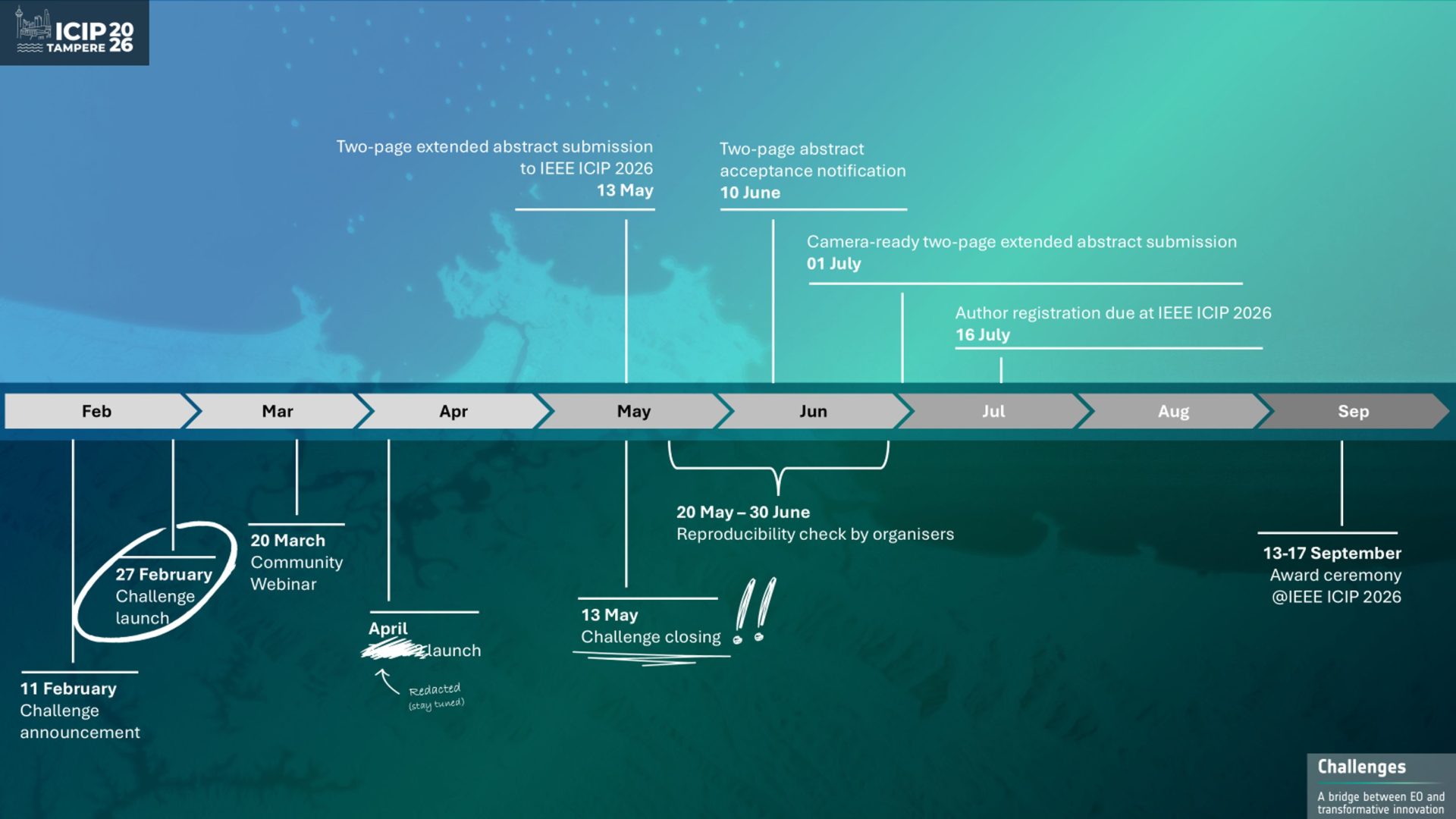
The team (behind the scenes)
Want a sneak peek behind the scenes? Meet the team of international AI and Earth Observation data science experts who have worked tirelessly to bring this exciting challenge to life.
Organizers and Chairs
 |
Jakub Nalepa Silesian University of Technology, KP Labs Poland  |
 |
Krzysztof Kotowski KP Labs, Poland |
 |
Bartosz Grabowski KP Labs Poland |
 |
Panče Panov Bias Variance Labs Slovenia |
 |
Tadej Tomanič Bias Variance Labs Slovenia |
 |
Alice Baudhuin |
 |
Jan Sotošek Bias Variance Labs Slovenia |
 |
Kevin Halsall Telespazio UK United Kingdom |
 |
James Harding Telespazio UK United Kingdom |
 |
Leonardo De Laurentiis Mission Management & Product Quality Division, European Space Agency Italy |
 |
Roberto Del Prete Φ-Lab, European Space Agency Italy |
 |
Lorenzo Papa Φ-Lab, European Space Agency Italy |
 |
Gabriele Meoni |
Why should you join?
Strengthen data quality at scale
Contribute solutions that improve the reliability of Sentinel-1 quicklook imagery used in large-scale Earth observation workflows.
Bridge research and operations
Apply AI methods to an operationally relevant problem using realistic data and constraints from the Sentinel-1 mission.
Benchmark what works in practice
Test and compare your approaches on a curated, annotated dataset with transparent and reproducible evaluation.